What Is a Data Lakehouse? Architecture, Benefits, and Use Cases
Why organizations use a lakehouse
Most analytics stacks split raw storage, ETL tooling, warehouses, governance, BI, and AI across separate systems. Every split copies data, strands metadata, and adds another system to operate. A lakehouse keeps data in open, scalable storage and adds the controls and performance patterns teams expect from analytical systems.
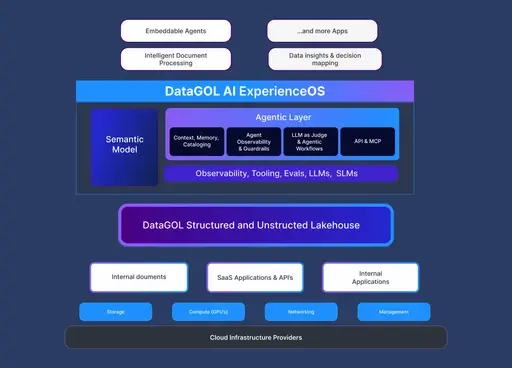
DataGOL's Lakehouse provides drag-and-drop pipelines, schema-change detection, access controls, materialized views, lineage, and warehouse persistence in formats such as Iceberg or Parquet. One governed foundation serves downstream analytics and AI, so each use case does not have to build its own copy.
How a lakehouse architecture works
The flow starts at source systems: relational databases, cloud warehouses, APIs, and object storage. Pipelines ingest that data, transform it into analysis-ready models, and persist it in a warehouse or table format suited to the workload. Orchestration coordinates dependent pipelines. Metadata and lineage record where each field came from and which downstream assets depend on it.
In DataGOL the sequence runs: connect sources, ingest through pipelines, manage dependencies with orchestration, refine with SQL or AI-assisted workflows, and publish curated results into workbooks. Workbooks then feed dashboards or agent-driven analysis.
Data lakehouse vs. data warehouse
A warehouse is built for structured analytics and governed reporting. A lake is built for cheap, flexible storage across many data types. A lakehouse keeps lake-style storage and adds warehouse-style reliability and governance. File location is the smallest part of the difference. What separates the three is how each handles transactions, schemas, metadata, access, lineage, and downstream consumption.
Where DataGOL fits
DataGOL puts DataOS, its data and context foundation, beneath AgentOS. The Lakehouse moves and prepares enterprise data. Playground, Workbooks, BI, and AI agents query, model, visualize, and converse with it. In this design the lakehouse is the operational layer that analytics products and governed AI experiences run on.
When a lakehouse is a good fit
A lakehouse fits when teams need to combine multiple enterprise sources, support engineering and analytics workflows side by side, cut repeated copies of curated data, maintain lineage, and make trusted data available to AI applications. The payoff is one governed path from source data to business consumption.

FAQ
Is a data lakehouse the same as a data warehouse?
No. A lakehouse borrows warehouse-style governance and analytical behavior while keeping the flexible storage patterns of a data lake.
Can a lakehouse support AI agents?
Yes. A governed lakehouse gives agents structured, traceable data to query. DataGOL connects its Lakehouse and data context layer to its agent capabilities.
Does DataGOL support incremental pipelines?
Yes. DataGOL documents incremental append and incremental merge modes, with cursor fields used to identify changes in supported configurations.
See how DataGOL connects pipelines, workbooks, BI, lineage, and task-specific agents on one governed foundation. Start with the documentation linked below.
DataGOL Documentation Hub — DataGOL Documentation

DataGOL Revolutionizes Retail Operations for FreshMenu
Problem
FreshMenu faced opportunities to scale efficiently by addressing fragmented data sources, lack of real-time operational visibility, and limited customer data for personalization.

Author
Vinod SP
Seasoned Data and Product leader with over 20 years of experience in launching and scaling global products for enterprises and SaaS start-ups. With a strong focus on Data Intelligence and Customer Experience platforms, driving innovation and growth in complex, high-impact environments