Built-In AI Governance: What to Look For in 2026
Every AI platform vendor will tell you they have governance built in. The badge on the pricing page says SOC 2. The sales deck has a slide called "Enterprise-Ready." And then you get into the actual evaluation and realize the "governance" is a compliance checklist PDF and a role-based access toggle that someone bolted on after the fact.
This is the governance gap that's quietly derailing enterprise AI rollouts in 2026. According to industry research, 98% of organizations have employees using unsanctioned AI tools, yet only 36% have a formal governance framework in place. That's not a strategy problem. That's a platform problem.
The real question isn't whether a platform has governance features. It's whether those features are enforced at runtime or just documented after the fact.
This guide cuts through the vendor noise. If you're a CTO or VP of Engineering evaluating AI platforms for a regulated or enterprise environment, here's what built-in governance actually looks like, and the questions you need to ask before you sign anything.
The Governance Theater Problem
Most platforms treat governance as a feature you add to an AI product. A few access controls here, a compliance badge there, maybe an audit log that exports to CSV if you know where to look. It looks credible in a demo. It falls apart in a real deployment.
The distinction that actually matters is enforcement mechanism: does the platform enforce policy at the point of data access and AI execution, or does it generate alerts for a human to act on later?
Post-hoc governance
Post-hoc governance documents what happened after the fact. It might flag a policy violation in a dashboard. It might send a Slack notification when a model accesses a sensitive data field. But by the time the alert fires, the data has already been processed, the response has already been generated, and the compliance event has already occurred.
This is governance theater. It creates the appearance of control without the substance.
Runtime enforcement (what actually protects you)
Runtime enforcement means the policy is evaluated before the AI touches the data. Access is granted or denied at the moment of the request, not reviewed after the fact. Audit trails are generated as a byproduct of normal operation, not assembled retroactively.
The EU AI Act's Article 50 transparency requirements take full effect in August 2026. Regulators will expect producible audit trails showing what data an AI system consumed, under what authority, and with what controls applied. Post-hoc governance cannot reliably produce this. Runtime enforcement makes it automatic.
Key distinction: Governance that operates outside the data path can be bypassed. Governance embedded in the data path cannot.
What Built-In Governance Actually Looks Like: An Evaluation Framework
A 2025 Gartner survey of 360 organizations found that enterprises using dedicated AI governance platforms are 3.4x more likely to achieve high governance effectiveness than those relying on manual processes. The gap between platforms that enforce and platforms that document is that large.
Here's the framework we'd use to evaluate any vendor's governance claims.
1. Data-layer coverage: does governance start at ingestion?
Governance that starts at the model layer is too late. By the time data reaches the model, it's already been ingested, transformed, and made accessible. Real governance starts at the data layer: what data is connected, how it's classified, who can access which fields, and whether PII is masked before it ever reaches an AI agent.
Ask vendors: "Show me how access control is enforced at the connector level, not just the API level."
2. RBAC and access controls: role-based or role-labeled?
There's a difference between a platform that has role-based access control and one that has role labels. The former actually restricts what data a given user or agent can query. The latter just displays a badge next to a user's name.
Real RBAC means:
Access permissions are enforced at query time, not display time
Different teams or tenants can operate on isolated data subsets within the same platform
SSO integration ties identity to data access automatically
3. Audit logging: native or bolted on?
Native audit logs are generated as a byproduct of every operation. Every query, every data access, every model invocation is logged automatically, with timestamps, user identity, and data lineage. Bolted-on audit logs require configuration, often miss edge cases, and are the first thing that breaks during a security incident.
Ask: "Can you show me a live audit trail from a real query in your environment, not a sample export?"
4. Regulatory framework coverage: breadth and depth
Single-framework compliance is a liability for any organization operating across jurisdictions. A platform that covers HIPAA but not GDPR, or SOC 2 but not the EU AI Act, creates patchwork coverage that exposes gaps. Evaluate:
Framework | What it covers | Who needs it |
|---|---|---|
SOC 2 Type II | Security, availability, confidentiality controls | SaaS companies, enterprise software |
HIPAA | Protected health information handling | Healthcare, health tech |
GDPR | EU personal data rights and processing rules | Any company with EU customers |
EU AI Act (2026) | High-risk AI system transparency and auditability | All enterprises deploying AI in the EU |
5. Zero data retention: does the platform keep your data?
This one gets missed in most evaluations. Some AI platforms retain query data, model inputs, or outputs for training or analytics purposes. In regulated industries, this is a non-starter. The platform should support zero data retention by default, with clear contractual commitments, not just a checkbox in the settings.
Why the Data Foundation Matters as Much as the Controls
Here's the part most governance evaluations miss entirely: you can have airtight access controls and still get confidently wrong AI outputs if the underlying data is ungoverned.
This is the structural gap in platforms that govern models without governing the data feeding those models. If your AI agents are pulling from fragmented, unvalidated, or inconsistently structured data sources, no amount of RBAC or audit logging fixes the output quality problem. Garbage in, governed garbage out.
Real AI governance requires a governed data foundation, not just a governed model layer.
That means:
A unified semantic model that understands your business context, not just raw table schemas
Data lineage tracking from ingestion through transformation through model consumption
PII detection and masking applied before data reaches any AI agent or LLM
Connectors that enforce data classification at the source, not after the fact
This is why enterprise teams in healthcare, finance, and regulated SaaS are increasingly looking for platforms that unify data infrastructure and AI deployment in a single governed stack, rather than stitching together a data warehouse, a governance layer, and an AI platform from three different vendors. The more handoffs between systems, the more governance gaps open up.
The Questions to Ask in Every AI Platform Demo
Before you commit to any platform, run these questions in the demo. The answers will tell you quickly whether you're looking at real governance or a well-designed slide deck.
"Show me how a policy violation is prevented, not just flagged." If the demo shows an alert dashboard, push back. Ask to see a live query blocked at the data layer.
"How is PII handled between data ingestion and model input?" The answer should describe automatic masking or field-level encryption, not a manual tagging workflow.
"What happens to my data after a query is processed?" Zero data retention should be the default, not an enterprise add-on.
"How do audit logs get generated, and what's in them?" Native logs include user identity, data lineage, and timestamp. Bolted-on logs require you to configure what gets captured.
"Which compliance frameworks are covered, and can you show me the audit reports?" SOC 2 Type II, HIPAA, and GDPR should all be producible on request, not promised for a future roadmap quarter.
These aren't trick questions. They're the baseline for any platform claiming enterprise-grade governance. A vendor that can't answer them live, in the product, isn't ready for your environment.
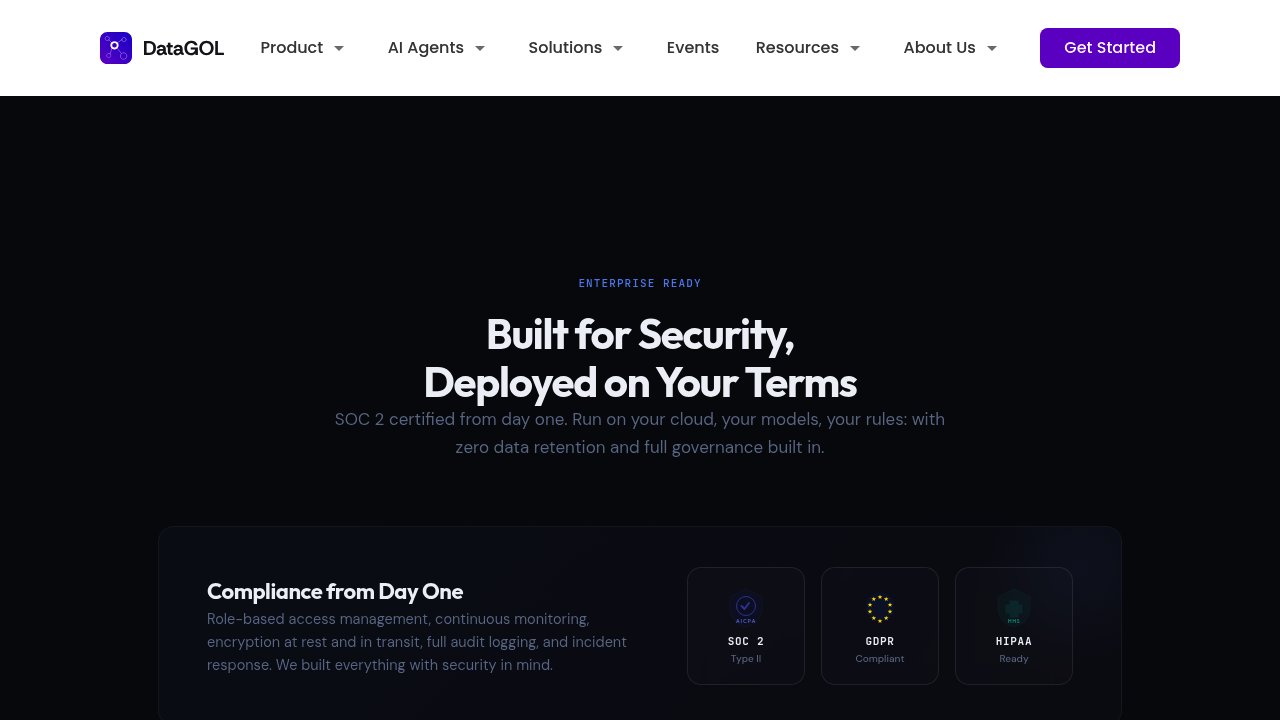
DataGOL is built to answer all five in the demo. With enterprise-grade security covering SOC 2 Type II, HIPAA, GDPR, encryption at rest, RBAC with SSO, native audit logging, an AI firewall, and zero data retention baked into the platform, governance isn't a feature we added. It's the foundation the entire platform runs on. And because data ingestion, semantic modeling, and AI deployment all live in one stack, there are no handoff gaps for policy to fall through.
If you're evaluating AI platforms for a regulated environment and want to see how governance works in practice, not in a slide, book a demo with the DataGOL team. We'll show you the controls live, in the product, against your data requirements.

DataGOL Accelerates Product Innovations for Remo
Problem
Building post event dashboards was too resource intensive, and less effective led to slowing their growth.

Author
Vinod SP
Seasoned Data and Product leader with over 20 years of experience in launching and scaling global products for enterprises and SaaS start-ups. With a strong focus on Data Intelligence and Customer Experience platforms, driving innovation and growth in complex, high-impact environments


