5 Best Advanced Analytics Tools in 2026: A Complete Guide
Introduction
The analytics landscape has fundamentally shifted. We’ve moved beyond static dashboards and manual querying into the era of agentic AI, where intelligent agents don’t just surface insights but proactively identify opportunities, recommend next steps, orchestrate workflows, and even take approved actions in real time. Yet mid-market companies still face the same constraints: they need enterprise-grade power without enterprise-sized data science teams, complex infrastructure, or six-figure implementation projects.
Picture this: You open your analytics platform and instead of rows of charts, an agent greets you with: “Your Q3 campaign is underperforming in the Midwest due to a 14% drop in mobile engagement, here are three targeted fixes, ranked by projected ROI. Shall I deploy the top one?”
That’s the 2026 reality forward-thinking teams are embracing.
At the end of the day, your team doesn’t need another tool that generates more reports. You need agent-driven, real-time intelligence that makes working with data dramatically easier and more impactful. That’s exactly why we’ve updated our guide for 2026, highlighting the platforms best positioned for mid-market organizations ready to move from reactive reporting to proactive, autonomous decision intelligence.
Let’s dive in.
Top advanced analytics tools for deeper, actionable insights
1. DataGOL
AI-Powered Analytics for Business Agility
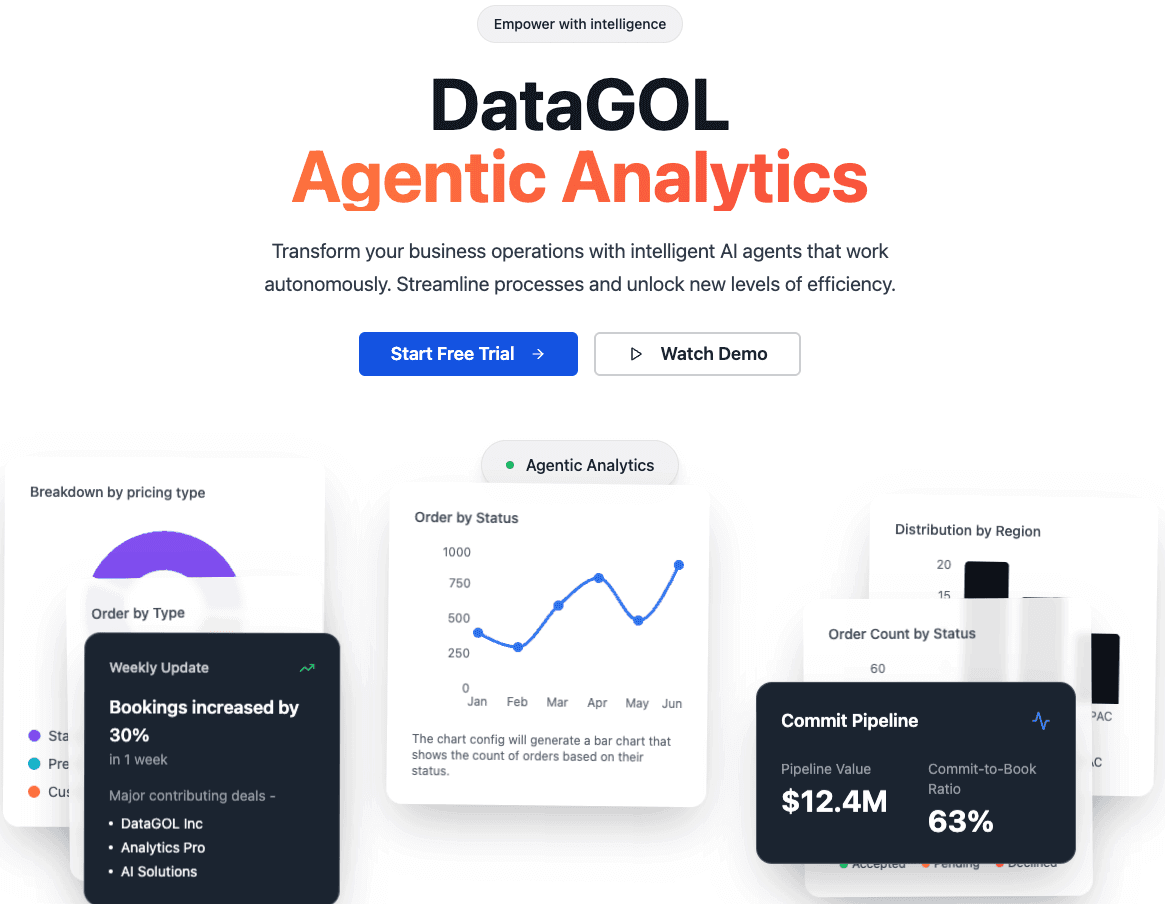
What it is: DataGOL is the leading AI-powered, agentic analytics platform purpose-built to unify data, analytics, and autonomous AI agents in a single, intuitive environment. In 2026, it continues to set the standard for mid-market companies that want true self-service intelligence without the overhead of traditional BI stacks.
DataGOL employs agentic AI “copilots” that not only answer users’ questions in natural language but also proactively find patterns and suggest next steps. In other words, the platform goes beyond static dashboards – it turns your data into a smart advisor, delivering insights and recommendations in real time. In addition, DataGOL automates repetitive data workflows via autonomous AI agents. Tasks like data cleaning, integration, and report generation run 24/7 in the background, freeing your team to focus on decisions instead of data wrangling. All data, analytics, and AI assets are unified in one place, providing a single source of truth and simplifying governance across the organization. As a result, organizations can achieve in weeks what might normally take months – many see a 10× faster time to value and dramatically lower total cost compared to piecemeal solutions.
Core features
Instant connectivity: 100+ pre-built connectors to databases, warehouses, SaaS apps, and real-time streams with zero configuration. Dashboards and agents update in real time.
Agentic AI analysis: Autonomous agents continuously monitor for trends, anomalies, root causes, and opportunities, delivering proactive insights and ranked action recommendations without any manual prompting.
Conversational + agentic interface: Business users ask complex questions in plain English (or voice) and receive instant answers, visualizations, and suggested next actions, complete with confidence scores and lineage.
Embedded agentic analytics & white-labeling: Deploy interactive, agent-powered experiences directly inside your products or internal tools in minutes.
Unified governance & multi-agent orchestration: Single source of truth with built-in lineage, role-based access, and the ability to coordinate multiple specialized agents for complex business processes.
Pros
Accessible to Non-Technical Users: DataGOL’s no-code, AI-driven interface empowers business users to explore data and get insights on their own, reducing reliance on specialized data analysts. This broad self-service analytics capability helps drive a data culture even in mid-size firms with smaller teams.
All-in-One Solution: Unlike many tools that focus only on visualization or require separate data prep and storage, DataGOL combines data integration, storage, analysis, and AI in one platform with faster performance. This simplifies the overall architecture and governance, as everything resides in one place. Mid-market companies benefit from not having to stitch together multiple tools.
Proactive Insights and Actions: The platform actively surfaces critical insights (trends, anomalies, predictions) without waiting for the user to dig, and it can even suggest next best actions. This “decision intelligence” orientation means DataGOL doesn’t just show data but helps you use it, which accelerates the move from analysis to tangible action.
Fast Time to Value: DataGOL’s automation and managed infrastructure enable very quick implementation and ROI. Companies have reported achieving results in a fraction of the time of traditional projects – for example, cutting analysis cycles by 50% and saving substantial costs in months. For resource-constrained teams, this agility is a major advantage.
Unified Data Governance: By providing a single source of truth and built-in data lineage tracking, DataGOL makes it easier to ensure data consistency and integrity across the business. Teams can trust that they’re all working with the same accurate data, which is crucial for scaling analytics in a mid-market organization.
Note: As an emerging platform, DataGOL is continually evolving its features. Companies evaluating it should consider how its all-in-one, AI-centric approach fits with their existing workflows. The integrated design, however, minimizes many of the integration and maintenance challenges seen with more fragmented solutions.
2. ThoughtSpot
ThoughtSpot has fully embraced the agentic era in 2026, positioning itself as an Agentic Analytics Platform. Its Google-like search now works alongside new Agentic Data Prep capabilities and MCP (Model Context Protocol) support, allowing AI agents and LLMs to interact securely with governed data models.
Core features: Natural language search with live results, AI-augmented Liveboards that proactively highlight anomalies, a next-generation Analyst Studio with agent-augmented data modeling and SpotCache for predictable AI workload costs, plus strong MCP server support for external agents.
Pros: Exceptional self-service adoption, excellent governance for agentic use cases, and real-time performance on cloud data platforms.
Cons: Best results still require well-modeled data upfront. Pricing starts around enterprise levels (base SaaS plans in the low thousands per month), which can be a stretch for smaller mid-market teams. The shift to fully agentic workflows introduces a new (but manageable) learning curve around agent management and governance.
3. Tableau
Tableau remains the gold standard for beautiful, interactive visualizations and has added powerful agentic capabilities in 2026 through Tableau Next and MCP integration with Agentforce. Agents can now query Tableau’s semantic layer directly for accurate, context-aware answers while respecting the Agentforce Trust Layer.
Core features: Drag-and-drop dashboarding, Tableau Prep, advanced analytics (forecasting, clustering), and new MCP connectors that turn any compatible AI agent into a “data expert” grounded in your business definitions.
Pros: Unmatched visual storytelling and customization. Strong ecosystem integration with Salesforce and now agentic extensions.
Cons: Advanced agentic and modeling features still favor teams with some technical depth. Performance on very large datasets can require optimization, and per-user licensing can add up quickly as adoption grows.
4. Microsoft Power BI
Power BI continues to win mid-market hearts with deep Microsoft 365 and Azure integration and expanding Copilot + agentic features. The 2026 updates include conversational in-report Copilot on mobile with follow-up questions, citations, and translytical task flows, letting users perform actions (update records, trigger workflows) directly inside reports.
Core features: Drag-and-drop authoring, robust DAX modeling, 100+ connectors, Copilot for natural language + auto-insights, and now action-oriented agentic capabilities within the Fabric ecosystem.
Pros: Seamless fit for Microsoft-centric organizations. Strong AI assistance and improving actionability. Attractive entry pricing.
Cons: Mastering advanced DAX and large-scale models still requires expertise. Licensing tiers (Pro, Premium per user/capacity) can become complex and costly at scale. Very large datasets benefit from careful modeling or Direct Lake mode.
5. Qlik
Qlik is an analytics platform known for its powerful data exploration and associative analytics engine. The company offers modern analytics solutions (such as Qlik Sense) that provide automated insights, natural language interaction, and even built-in data integration capabilities (bolstered by Qlik’s acquisition of Talend for ETL). Qlik’s tools enable analysts and business users to combine data from multiple sources and create interactive visualizations, while also supporting advanced operations like statistical modeling, forecasting, and what-if scenario analysis. The hallmark of Qlik is its associative data engine, which allows users to freely navigate data—making selections on a dashboard automatically highlights related data across the entire model, revealing hidden connections.
Core features: Qlik’s platform covers a range of advanced analytics needs. Key features include robust data integration, allowing you to connect and consolidate data from cloud data warehouses, ERP/CRM systems, spreadsheets, and more into Qlik’s analytics environment. The associative engine ensures that all your data is linked, so users can explore it without predefined drill paths. Qlik offers rich data visualization options; users can create custom dashboards and interactive charts for storytelling and analysis. The platform also has augmented analytics capabilities: an AI assistant for natural language queries and AutoML features for things like forecasting outcomes and generating predictive models from your data. Real-time capabilities are another focus – Qlik can perform real-time monitoring of key metrics, updating dashboards as underlying data changes to always reflect the latest state of the business. These features make Qlik suitable for scenarios where timely insight is critical.
Pros: Qlik is often praised for its flexible, user-driven data exploration. Its drag-and-drop interface and associative filtering allow users to slice and dice data in a very ad hoc manner, which is great for discovery analytics. Another strength is Qlik’s support for a wide variety of data sources and connectors, making it relatively easy to bring together data from many systems. This is important for mid-market firms that might have data spread across cloud apps and on-premise databases – Qlik is built to unify those. Qlik also provides strong performance on large datasets due to its in-memory engine and has enterprise features like robust security and scalability (especially in its Cloud editions). The platform’s recent AI enhancements (like Insight Advisor) can automatically generate analyses or suggest visuals, assisting users in getting started with their data.
Cons: One potential drawback of Qlik is that for complex or very large data sets, data reloads or refreshes may need to be managed carefully (sometimes even manually). While Qlik can handle big data, ensuring that the data remains up-to-date might require additional configuration or use of incremental load techniques; otherwise, users might encounter stale data or performance issues. The initial setup and learning curve can also be steeper than some competitors. Deploying Qlik in an organization often involves significant planning – you need to script data load processes, design the data model, and configure the environment, which might require specialized Qlik developers or training for your team. For a mid-market company with limited IT staff, this could be a challenge. Additionally, some industry analysts have noted that while Qlik has introduced AI features, it’s not yet clear if Qlik is advancing its AI capabilities as fast as the market leaders are. In other words, in the race to embed cutting-edge AI (like generative AI and advanced natural language processing) into analytics, Qlik is playing catch-up. Finally, Qlik’s licensing can be complex to navigate (multiple products and tiers), and costs might add up if you require both its analytics tools and data integration (ETL) tools.
Key Considerations for Mid‑Market Analytics Solutions
In 2026, advanced analytics is no longer about staring at prettier charts. It’s about deploying intelligent agents that turn data into autonomous action at scale. The platforms we’ve reviewed all offer strong capabilities, but DataGOL stands out for mid-market organizations seeking the perfect balance of power, simplicity, and speed.
By combining unified data + analytics + multi-agent orchestration in one governed platform, DataGOL lets lean teams achieve what used to require armies of analysts and months of integration work. It turns messy, real-world data into proactive recommendations and automated workflows, all accessible through natural language.
The future of analytics belongs to organizations that stop treating data as a rear-view mirror and start using agentic intelligence as a co-pilot (and sometimes autopilot) for growth. DataGOL is purpose-built for exactly that future, delivering actionable intelligence at the speed your business moves.
Ready to see what agentic analytics can do for your team in 2026? Start with a focused proof-of-concept on your highest-impact use case. The right platform won’t just show you the data. It will help you act on it, faster than ever before.
Which tool are you most excited to evaluate this year? Drop your thoughts in the comments. We read every one.
Here are some key considerations:
Align with Your Business Goals: Be clear about what you need from analytics. Are you trying to speed up everyday decision-making, uncover new revenue opportunities, or something else? Without crystal-clear objectives, you risk investing in a tool that looks powerful but doesn’t truly align with your business priorities. Define success metrics (e.g. reduce reporting time by 50%, increase marketing ROI) and use them to evaluate each tool’s potential impact.
Action-Oriented Analytics: Data is only valuable if it leads to action. Prioritize solutions that not only give you access to data but also empower your team to act on insights quickly. The right tool will let users effortlessly query data (ideally in natural language) and instantly get answers, so teams can move from analysis to action faster. If a platform offers automation (like triggering alerts or workflows from insights), that’s a big plus for turning insight into real business change.
Weigh Strengths and Trade-offs: Every tool has its strengths and limitations. Some platforms excel at scalability and handling big data but might require extensive training or IT support; others are very easy to use but may lack deep analytical capabilities. Also consider integration – will the tool fit into your existing tech stack smoothly (connecting to your databases, cloud services, etc.)? And what about the total cost of ownership (licenses, infrastructure, maintenance)? Mid-market firms should carefully weigh these trade-offs to choose a solution that meets both current needs and long-term growth.
Consider the User Skill Gap: Even the most powerful analytics tool is useless if the people who need to use it can’t. Think about the primary users – are they business folks with limited technical skills, or experienced data analysts, or a mix? Make sure the platform is intuitive enough for your non-technical users so that adoption will be high. Training requirements should be reasonable. Often, a slightly less feature-rich tool that everyone can actually use will drive more value than an advanced tool that sits on the shelf because it’s too complex. The ideal solution will cater to different skill levels (e.g. simple AI-assisted querying for casual users and advanced options for power users).
By keeping these considerations in mind, mid-market companies can better assess which analytics platform will deliver the best balance of power and practicality for their situation. In many cases, the decision comes down to which tool will empower your team the most to make data-driven decisions daily.
Conclusion
Advanced analytics tools have become essential for turning the mountain of data that organizations collect into meaningful business outcomes. For mid-market businesses, selecting the right platform can be a game-changer – the difference between being overwhelmed by data and creating a truly data-driven culture. The landscape of analytics and BI is evolving faster than ever, especially with new AI-driven capabilities emerging continually. It’s easy for teams to get bogged down by complex tools, so it’s critical to choose a solution that will empower your users rather than intimidate them.
Each of the platforms discussed – DataGOL, ThoughtSpot, Tableau, Power BI, and Qlik – offers unique strengths. Legacy players like Tableau and Qlik provide rich features for those with the right expertise; ThoughtSpot brings cutting-edge AI search to the forefront; Power BI delivers convenience and integration for Microsoft-centric businesses. But DataGOL stands out for mid-market organizations due to its holistic approach. By combining data integration, AI-powered analysis, and automation in a single easy-to-use platform, DataGOL enables companies to leverage advanced analytics without the usual complexity or heavy upfront investment in infrastructure. It is purpose-built to make AI and analytics work for you, so that even lean teams can unlock insights from their data and translate them into action quickly.
In summary, mid-market companies seeking advanced analytics should look for a tool that delivers quick time-to-value, is scalable as they grow, and most importantly is embraced by its users. DataGOL’s innovative “agentic” analytics approach answers questions from messy, real-world datasets, giving users the confidence to take instant action. No more waiting on dashboards or sifting through complex reports–just actionable insight that drives smarter decisions. By carefully evaluating your options and considering the factors outlined in this paper, you can navigate the analytics landscape with confidence and choose a platform that turns your data into a driver of competitive advantage. In an era where data is abundant but actionable insight is the true currency, selecting the right analytics partner – one that fits your needs and empowers your people – will set your organization on the path to smarter, faster, and more informed decision-making.
Want to experience this for yourself? Get a free demo from our team to get started!

DataGOL Empowers a SaaS Company to Leapfrog their Competition
Problem
A leading SaaS company faced a common and growing challenge — empowering their customers with meaningful analytics and data autonomy while maintaining control over compliance, sovereignty, and cost.

Author
Vinod SP
Seasoned Data and Product leader with over 20 years of experience in launching and scaling global products for enterprises and SaaS start-ups. With a strong focus on Data Intelligence and Customer Experience platforms, driving innovation and growth in complex, high-impact environments


