8 Steps to Ship AI Features Faster | DataGOL
Why AI Feature Setup Drags On for Months
Most teams stall because getting a model into production requires connected data, shaped context, access controls, orchestration, and guardrails. That's five distinct engineering workstreams before a single user sees anything.
The numbers back this up. According to Master of Code, 68% of institutions have moved fewer than 30% of their AI experiments into production, and 62% of companies are still stuck in experimenting or piloting phases.
If your first AI feature is taking longer than expected, you're not behind. You're running into a systems problem that's consistent across the market.
The four bottlenecks we see most often:
Fragmented data: Business context is spread across Salesforce, Stripe, NetSuite, and a dozen other systems with no unified access layer.
Context assembly: Turning raw data into something a model can reason over requires cleaning, normalization, and semantic shaping that nobody budgeted for.
Orchestration and permissions: Routing requests, enforcing access controls, and managing multi-step agent workflows is weeks of platform work before the feature logic starts.
Governance scaffolding: Security, audit trails, and guardrails are now core product requirements, not afterthoughts, as Progress notes in their 2026 AI trends report.
The real urgency is time-to-production, because technical teams are being judged on shipped capability.
The Hidden Work Nobody Budgets For
Here's what we've seen consistently: a team scopes a first AI feature, estimates six weeks of engineering, and then watches the timeline expand to six months. Not because the feature was wrong, but because the feature inherited a fragmented data environment.
What looks like a simple feature quickly surfaces as a much larger workload:
Data access: Connectors need to be built or licensed for every relevant system. Each one has its own schema, auth model, and update cadence.
Context shaping: Raw records don't become useful AI context automatically. Definitions need to be normalized, relationships mapped, and boundaries set so the model reasons over the right scope.
Orchestration glue: Routing, retries, tool calls, memory, and multi-step flows require agent scaffolding that most teams build from scratch.
Human review and evaluation: Before a feature goes to production, you need eval harnesses, human-in-the-loop checkpoints, and a way to catch regressions.
Monitoring and guardrails: As Microsoft's 2026 AI trends report describes, AI is moving toward systems that act and embed into workflows, which means trust controls aren't optional post-launch.
This is where stack assembly fatigue shows up. Engineering time disappears into platform work instead of the product differentiation that actually matters. Setup friction in AI projects is rarely about the model. It's about strategy, data, and operating model, and none of that work shows up in initial sprint estimates.
What to Own, What to Rent
The build-vs-buy debate is the wrong frame. The real question is: what should be proprietary in your product versus what should be rented as infrastructure?
"The real question is 'What do we own vs. rent?' rather than 'build vs. buy.'" — C4 Tech Services
Menlo Ventures' 2025 State of AI report found that 76% of AI use cases are purchased rather than built. Meanwhile, Retool's 2026 survey shows 39% of companies replacing SaaS with custom builds and 78% planning to build more. Teams are mixing approaches, which is the right instinct. The error is mixing them in the wrong places.
Own this | Rent this |
User experience and product surface | Data connector infrastructure |
Domain logic and business rules | Context assembly and normalization |
Differentiated workflow design | Agent scaffolding and orchestration |
Feature roadmap and prioritization | Governance, permissions, and audit trails |
Evaluation criteria specific to your domain | Monitoring and eval harness tooling |
Skipping non-differentiated setup is how you compress timelines without giving up control. Your team's scarce engineering time should go into the rows on the left. Everything on the right is infrastructure that someone else has already built and hardened.
A Practical 8-10 Week Path to a First Shipped Feature
The 2026 Enterprise AI Implementation Guide notes that strategy and use-case definition alone typically takes 4-8 weeks, and an initial pilot commonly runs 12-20 weeks. That's the default path. Here's a compressed one.
Weeks 1-2: Scope ruthlessly Pick one high-value workflow, one buyer persona, and the exact business systems that hold the relevant context. Don't start with a platform audit. Start with the question: what's the one thing this feature needs to do well to be worth shipping?
Weeks 3-5: Build the data layer, not the feature Connect and normalize the relevant data sources. Define permissions and access boundaries. Create reusable business context instead of one-off prompts. This is the work that determines whether the feature holds up in production or breaks under real usage.
Weeks 6-8: Build the feature logic With clean, governed context already in place, feature development moves fast. Focus on the interaction model, evaluation against real queries, human review checkpoints, and production guardrails. According to Larridin's 2026 developer productivity benchmarks, AI-assisted workflows improve time-to-production by 20-60% for typical app features when the data layer is already sorted.
Weeks 9-10: Launch readiness Monitoring, rollback paths, trust controls, and a governed release. Not a big bang, a narrow production deployment that proves the workflow and gives you a foundation to iterate on.
The sequence matters. Teams that try to build the feature before the data layer is ready spend weeks 6-10 debugging context problems instead of shipping.
What This Looks Like in Practice with DataGOL
The 8-10 week path above assumes the data layer work in weeks 3-5 gets done cleanly. That's where most teams hit the real friction, and where DataGOL changes the execution math.
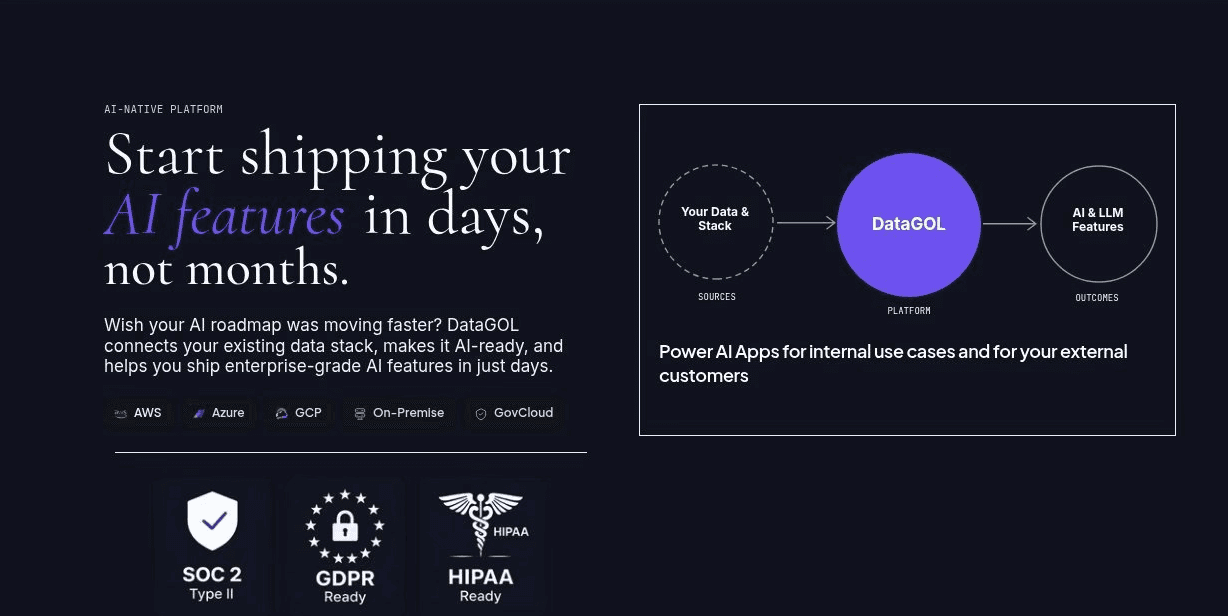
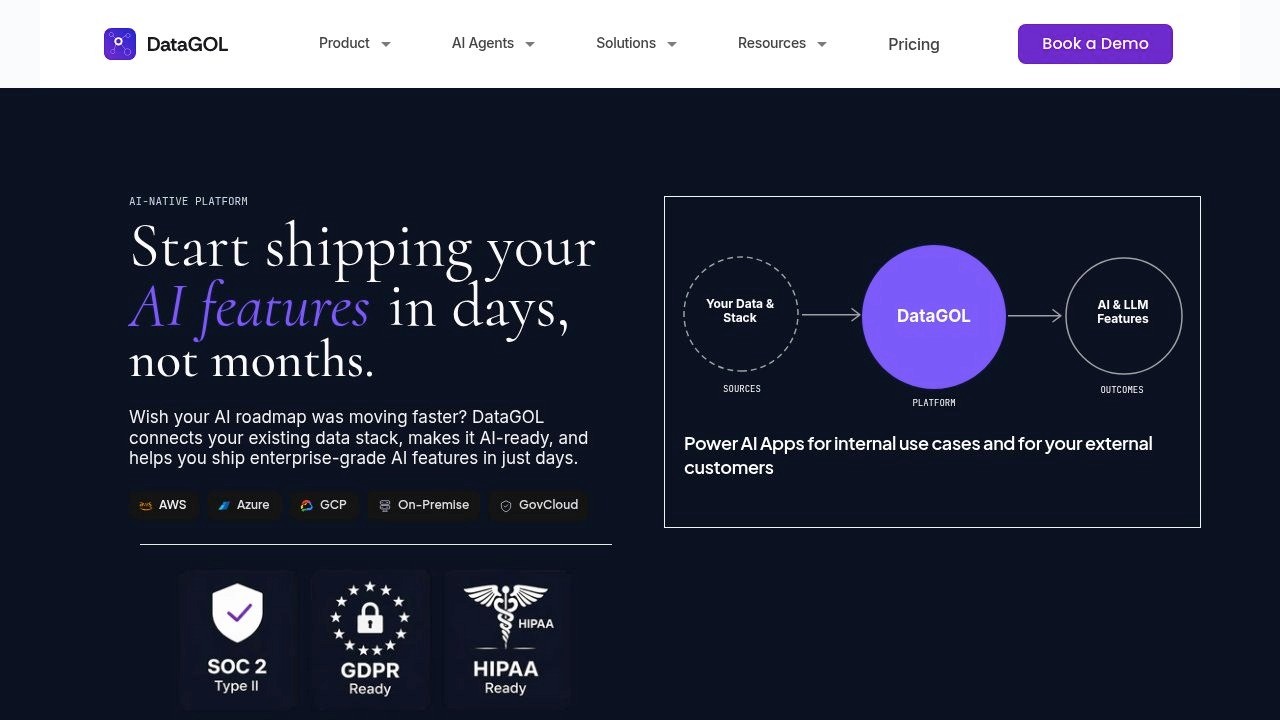
We built DataGOL to be the layer underneath governed AI agents: 100+ pre-built connectors across systems like Salesforce, Stripe, NetSuite, Segment, and HubSpot, with context assembly, permissions, and governance built into the same platform. The work that typically consumes the first half of an AI project is absorbed before your team writes a single line of feature logic.
Three things this changes in practice:
No separate data preparation phase. Context is AI-ready from day one, not after a cleanup sprint that bleeds into the feature timeline.
Reusable business context, not one-off prompts. The context layer you build for feature one is the foundation for every feature after it. The investment compounds.
Governance isn't bolted on. Access controls, audit trails, and trust controls are embedded in the platform, not a separate integration your team has to maintain.
For a deeper look at how the platform compresses the full AI feature development lifecycle, see our post on how to ship AI features faster.
If You Need a Real AI Feature This Quarter, Start Here
MIT Sloan research found that 95% of enterprise generative AI pilots have produced no measurable P&L impact. The common thread isn't a bad model choice. It's infrastructure-heavy experiments that never tighten into a production feature with a defined workflow and real users.
Don't start by assembling the entire stack. Start by removing the setup work that doesn't create product advantage. A first shipped AI feature should prove a workflow, not prove your team's ability to wire six infrastructure tools together.
The fastest credible path is an integrated, governed layer that lets your team ship in weeks, not quarters.
Your first governed AI feature shouldn't take a quarter of stack assembly to reach production.
See how DataGOL gets you there in 8-10 weeks — Book a demo →


Author
Vinod SP
Seasoned Data and Product leader with over 20 years of experience in launching and scaling global products for enterprises and SaaS start-ups. With a strong focus on Data Intelligence and Customer Experience platforms, driving innovation and growth in complex, high-impact environments


